


Newly deciphered interpretations of Papers 1 and 3 reveal the coded journal of Gilbert Bean, a Revolutionary War minister whose records, service, and mysterious “ark” raise unresolved historical questions.

Author James Becker is the great-grandson of Patriot Jacob Becker. Jacob Becker was the emissary sent to France to secure funds to finance the American Revolution. As a result, ten shiploads of Solomonic treasure was sent to America. George Washington had it buried in caves in western Pennsylvania. President Franklin Roosevelt had the gold transferred to Fort Knox. This transaction is recorded in Secret Treaty Number One. The information has been maintained down through the Becker generations with other information about the Revolution and other government incidents recorded in this book.

Contents in the trove. Note: A sol Mosaic arc brims in a boys moc arc at lea. When Gilbert Bean and his mother went inside the cave to investigate, they found an Indian toddler laid to rest on a mound inside the cave. There had been an Indian campground near this area. (“C” was sometimes substituted for “k” throughout the code)


A sheet taken from professional archaeologist Dave Decker’s report indicating areas of interest on the hill described in the code.

The underground railroad ran through the area of Bean’s Cove. A runaway slave girl lived in a cave atop the promontory that jutted out toward the cove. She helped Bet Bean Beale in the kitchen at the inn. When Henry Lee was at the inn and saw Eloee, the slave girl. He was attracted to her beauty and fell in love with her. They had an affair and a son was born to them. The little earl was the love of Lee’s life. This affair has been kept secret until revealed in Gilbert Bean's journal.


A geographical picture of the hill where the vault is buried and the exact spot indicated by the dropped pin.


The cover page for Dave Decker’s report.

A copy of the original deed made out to William Perdew Jr described in the code.

Journal entries describing the location and deed.
Communication with Don Carns, a gentleman who tried to convince me the map indicated the trove was on the “Eby” place about a mile down the road closer to his home. He was not aware of the research I had done or the journal entries I had deciphered.


There were three sets of number in the Beale ciphers. One set had been deciphered before the code became popular. It stated the trove was about four miles from Buford’s. This is a map in Bedford County, Virginia highlighting the area around Bufords now called Montvale

An early survey map in Bedford County. Pennsylvania of the plot sold at public auction to William Perdew Jr. showing the adjoining land as Buford’s land.”

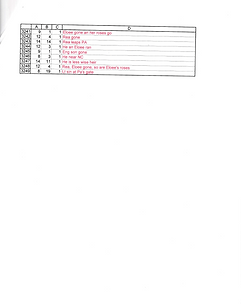
The words in one of the decoded papers is aligned to show a diagram of the hill using the “E” in the words. And, it also shows where the pit is on the ledge and where it is located.

The Beale ciphers are coded twice. Gilbert coded the information and then he coded the code. This is a picture of the first coding.

This is a picture of the first coding of another sheet of the numbers and also showing a diagram of the hill indicating where the diagram is located in the code.

An introduction from the pamphlet concerning the Beale code published by the Beale Cipher Association.


An article written by George Hart of Bedford County, Virginia, found in the pamphlet published by the Beale Cipher Association. This article was stored in the public library in Roanoke, Virginia. The most interesting story I have found concerning the experience of trying to solve the Thomas Jefferson Beale ciphers and the search for the trove even to resorting to hypnotism. Depending on your sense of humor, it is also comical. A good story to read for entertainment.

The genealogy of the William Perdew, Jr. family. William Perdew was the first legal owner of the property where the trove is located, but Gilbert Bean writes in his journal William didn’t know about the trove and it was safe. Elijah Perdew is also named in the code.

A translation of Beale paper Number two, the first paper in the code deciphered.

A copy of Gilbert Bean’s military record received from the National Archives. Gilbert served in the Maryland Rawlings Regiment and is listed as deserted.

The “forward” from the pamphlet published by the Beale Cipher Association.


Journal entries describing the Ark of the Covenant and explaining how it functions.


Preservation of the trove. Explains how they built the underground vault and the care that was taken to make it waterproof.
The record of an event during the American Revolution. Lee sent out ten men in a boat for a “watch” including Gilbert Bean. They had been out for several hours. They were hot and restless with no water to drink. They decided to go ashore. Ten others were sent out in their place as the others watched from shore, the ten that went out were spotted by the British and were blown up. Foam rose from the water and men’s shoes and debris began to wash up on shore. The men on shore wept.

Another copy of the contents of the trove.


The picture of the brick house: When the land was auctioned off following the Revolution, Gilbert Bean lost the bid. It was deeded to a William Perdew. The brick house was built by the Perdew family 1n 1854 with home-made brick. It now belongs to the Cessna family who continue to live there.

The half picture shows the GPR I hired to go over the area. It is probably sitting on top of the trove. The pictures were taken by me and are therefore legal. The guys not shown were the young man in charge of the GPR and Carl Cessna, one of the owners of the land.


The picture of the line of trees is the top of the rock wall where the entrance to the grotto existed. The graves of two little boys were buried there but have been farmed over.
